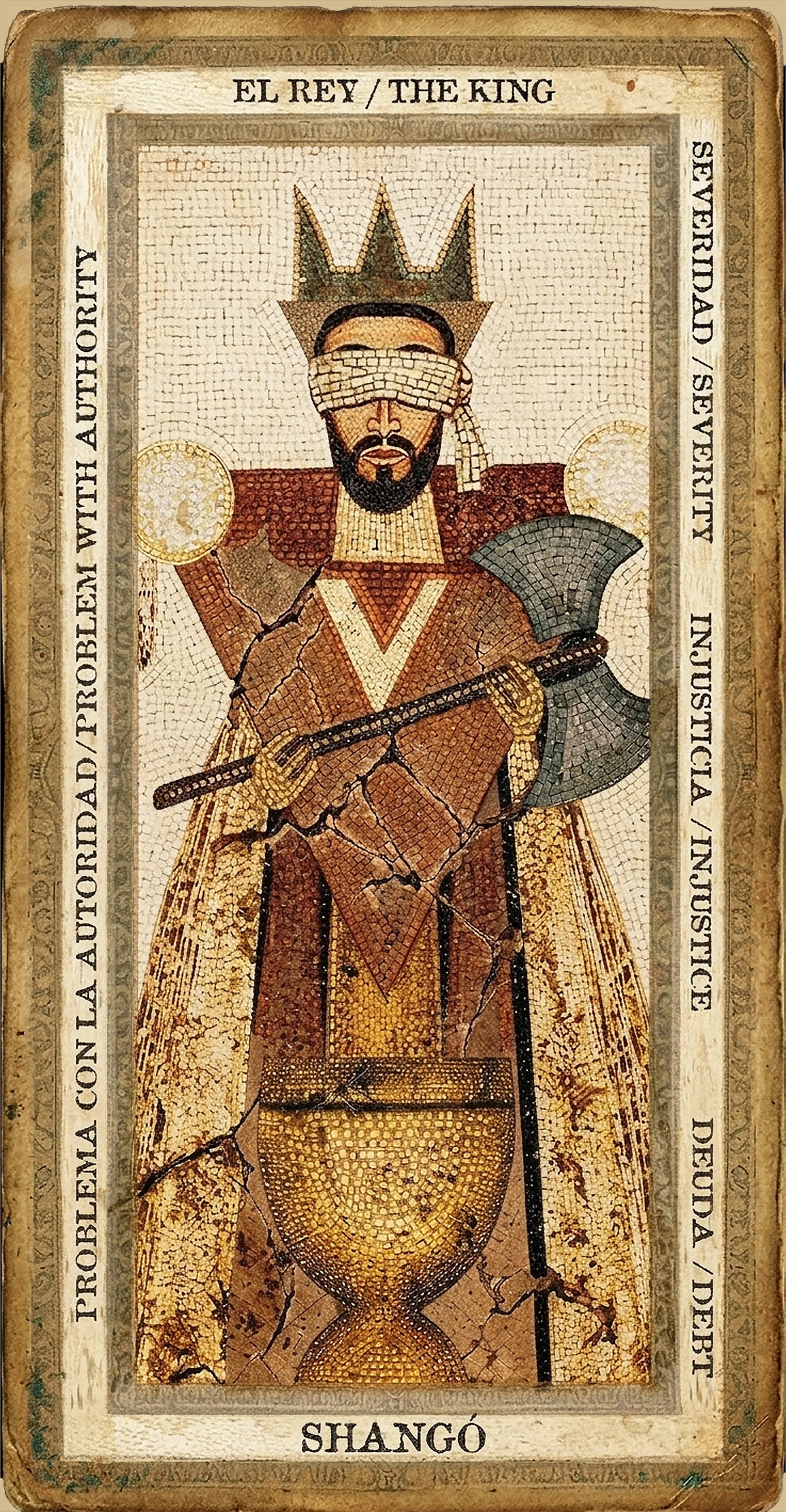
Shangó in shadow indicates that the scales are alive, but not at peace. There is an energetic knot tied to justice, both earthly—courts, rules, contracts, decisions—and moral: unsettled accounts, debts to be paid, merits left unrecognized, wrongs suffered or committed that have not yet found their form of repair. In shadow, Shangó does not arrive to “punish”: he arrives because something weighs more than something else, and you can feel it, even if you do not yet know how to name it. It may be a neglected problem returning to knock at your door, a promise made too lightly, an ambiguous agreement, or a past that is presenting its bill in the form of exhaustion, irritation, paranoia, shame, or the need to be right.
As a king appearing in shadow, Shangó often points to a theme of authority: the authority you exercise and that is not being respected—children who do not listen, people who override you, boundaries that do not hold—or the authority you are forced to endure: a boss, an institution, a family, a “supposed to” that crushes you. Here justice risks turning into rigidity, control, severity, or the opposite: surrender, passivity, flight from responsibility. Shangó in shadow shows you where power has become distorted and where order has turned into tension.
If the problem is within you, Shangó places before you a subtle temptation: to confuse justice with revenge, merit with ego, authority with imposition. Perhaps you are demanding an immediate verdict from life, or you want to “win” more than you want to understand. Perhaps you are judging yourself without appeal, or judging others as if the world were a permanent courtroom. The advice here is simple and difficult: return to the facts. Ask yourself what really happened, what you promised, what you received, what you gave, and where you left a debt—emotional, practical, or moral—unsettled. Not in order to blame yourself, but in order to restore balance.
If the problem is around you, Shangó in shadow warns you that you are entering a field where evidence, boundaries, rules, and clarity matter. Someone may not be loyal, or a situation may be more political than it appears. There may be legal, financial, or managerial matters that need to be taken seriously before they deteriorate. Here Shangó is not asking you to trust: he is asking you to document, to organize, to set limits, and to ask for what is yours with firmness and without theatrics. And above all: do not let fear of judgment make you invisible.
Question: where is the imbalance—between giving and receiving, between power and responsibility, between truth and pride—that is now asking to be corrected?

I do not know what you asked, dear seeker, but if Shangó has appeared in his shadow aspect, he wants you to know the following:
(and only you can know whether these words are speaking to you, or whether they are pointing you toward words that need to be spoken to someone around you)
THE QUESTION AND THE RECOMMENDATION, HOWEVER, ARE FOR YOU