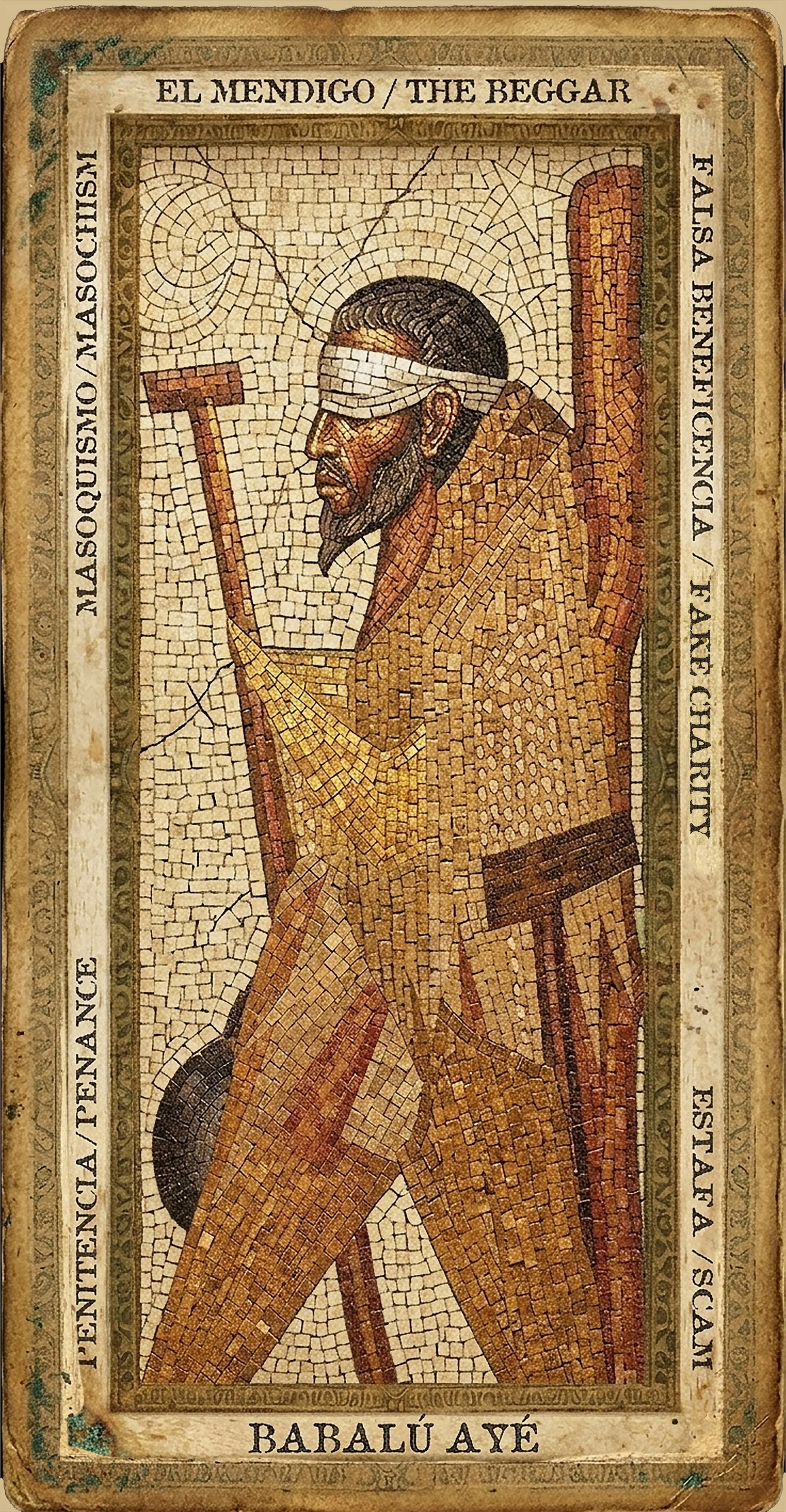
Babalú Ayé in his shadow points to a distortion in the theme of care: attention to pain or need becomes excess, mask, or dependence. Here compassion does not liberate, it holds back; help does not heal, it creates debt; fragility is not recognized with love, but used as an identity. When this card appears, it suggests that the answer to your personal question passes through understanding where “goodness” has become imbalance.
If the problem is within you, Babalú Ayé may reveal two extremes. On one side, there is the altruism that empties you: you save, repair, take everything upon yourself, and meanwhile consume yourself, as if you were worth something only when you are useful. On the other side, there is defensive hardness: you shut yourself off, you do not want to feel anyone else, because associating need with weakness frightens or irritates you. In this shadow, victimhood may also appear: feeling sorry for yourself, believing yourself to be “the last” so as not to take risks, seeking constant attention, or clinging to the role of the wounded one because it gives you a safe place in the world. Sometimes even suffering becomes a language for obtaining love.
If the problem is around you, Babalú Ayé speaks of ambiguous dynamics: self-interested help disguised as generosity, goodness used as a bargaining chip, care used as a form of control. It may also indicate people who demand endless attention, who seek pity more than solution, who turn everything into an emergency, or situations in which fragility is displayed, exaggerated, or even invented in order to gain protection, advantage, or emotional power. In this field, the question is not “who suffers more,” but “who is using suffering to govern the relationship.”
If the card appears first, it indicates that the answer to your question first passes through observing where there may be a misunderstanding. Is there something that should be good and yet, if you think carefully, is not? Or is there in you, or around you, a false helper, a false poor person, a false sick person?
If it appears after a light card, it serves as a warning: while pursuing virtue, be careful not to do so for the needs of your ego.
And try asking yourself one question:
Is there a “wound” (real or narrated) that keeps being reopened because it brings attention, presence, or control?

I do not know what you asked, dear seeker, but if Babalú Ayé has appeared in his shadow aspect, he wants you to know the following:
(and only you can know whether these words are speaking to you, or whether they are pointing you toward words that need to be spoken to someone around you)
THE QUESTION AND THE RECOMMENDATION, HOWEVER, ARE FOR YOU